How to Prepare for an Interview: Complete Guide (2026)
Feeling overwhelmed by interview preparation? You're not alone. According to Indeed's 2024 Workforce Insights Report (surveying 5,000+ U.S. workers), 71% of workers are open to new opportunities, but only 28% research the company's interview process—they show up hoping for the best. The hidden blocker isn't a lack of experience. It's treating interviews as isolated events instead of a systematic process.
Let's build a plan to solve it.
Think of interview preparation like programming a GPS before a road trip. You wouldn't start driving without knowing your destination, checking traffic, or planning rest stops. Yet most candidates approach interviews blind—no research, no practice, no strategy. Top candidates in 2025 treat interviews like a marketing campaign: research your audience (the company), craft your message (your answers), test your setup (video interview), and measure results (follow-up).
This guide gives you that systematic framework. You'll walk away with a 7-point company research framework, STAR method templates, a technical setup checklist, follow-up email templates, and a readiness scorecard. These aren't generic tips—they're actionable steps you can implement immediately.
Step 1: Research the Company Like You're Preparing a Pitch
Action: Open your browser and complete the 7-point research framework below. Set aside 2-3 hours for this. Don't skip steps.
Why: Recruiters spend an average of 15 minutes on initial phone screenings, according to HiringThing's job application statistics. When you match their effort with thorough preparation, you demonstrate genuine interest and stand out from the majority who skip this step. This research gives you conversation material, helps you ask informed questions, and shows you understand their business.
Example: Skip generic statements like "I'm excited about your company's growth." Instead, reference specific details: "I noticed your Series B funding round last quarter and your expansion into the European market. How is that affecting the product roadmap?" This demonstrates you did your homework.
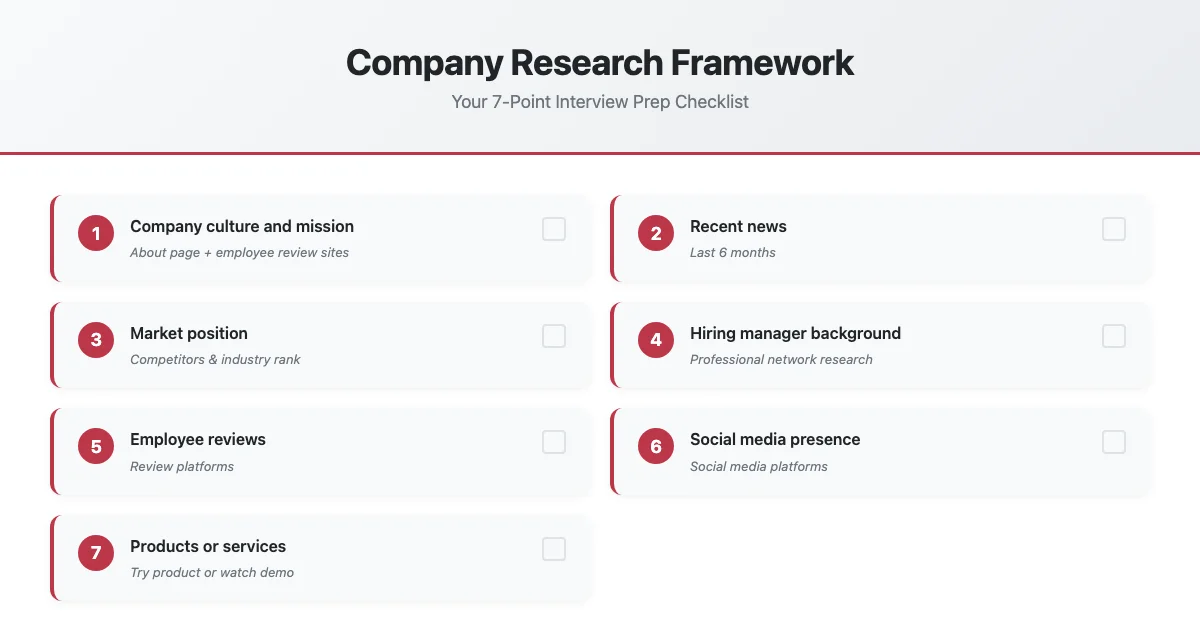
The 7-Point Research Framework
1. Company culture and mission. Read their "About" page, but don't stop there. Check employee testimonials on Glassdoor and Indeed to see if stated values match reality. Look for patterns: Do people mention work-life balance? Growth opportunities? Management style?
2. Recent news. Search "[Company Name] news" and filter to the last six months. Funding rounds, product launches, and leadership changes give you conversation material. Mentioning a recent Series B round or new product line shows you're paying attention.
3. Market position. Who are their main competitors? Where do they rank in the industry? Understanding this context helps you frame answers around their strategic goals. If they're competing with a larger player, emphasize your scrappy, resourceful approach.
4. Hiring manager background. Research them on LinkedIn. Look at their background, posts, and shared connections. Finding common ground (same university, previous employer, or industry interest) builds instant rapport. "I noticed you worked at [Company X]—I was there from 2019 to 2021" is an instant conversation starter.
5. Employee reviews. Glassdoor and Indeed reveal what it's really like there. Pay attention to recurring themes in both positive and negative reviews. If multiple people mention unclear expectations, you can ask clarifying questions about role definition during the interview.
6. Social media presence. How do they present themselves on LinkedIn, Twitter, or Instagram? What content do they share? This reveals their employer brand and helps you align your language with theirs.
7. Products or services. Understand them from a customer perspective. Try their product if possible, or watch demo videos. Being able to discuss their offering from a user's viewpoint demonstrates genuine interest beyond just landing a job.
 Make sure your resume optimization aligns with everything you've learned about the company and role. Your resume should reflect their language and priorities.
If this feels overwhelming, start small. Pick just one point—the hiring manager's LinkedIn profile. Spend 15 minutes there. You'll see how valuable this research is when you find common ground in the interview.
Once you've completed your research, use FoundRole's company research tool to see their current openings, salary ranges, and team structure. You'll get additional context that makes your interview conversations more informed.
Step 2: Prepare Your Answers Using the STAR Method
Action: Open a document and write 5-7 STAR stories covering different competencies. Practice each one out loud. Don't memorize word-for-word—know the key points.
Why: Having great experience means nothing if you can't articulate it clearly. The STAR method gives you a framework to tell compelling stories that interviewers remember. Most candidates ramble or give vague answers. Structured stories with specific results make you stand out.
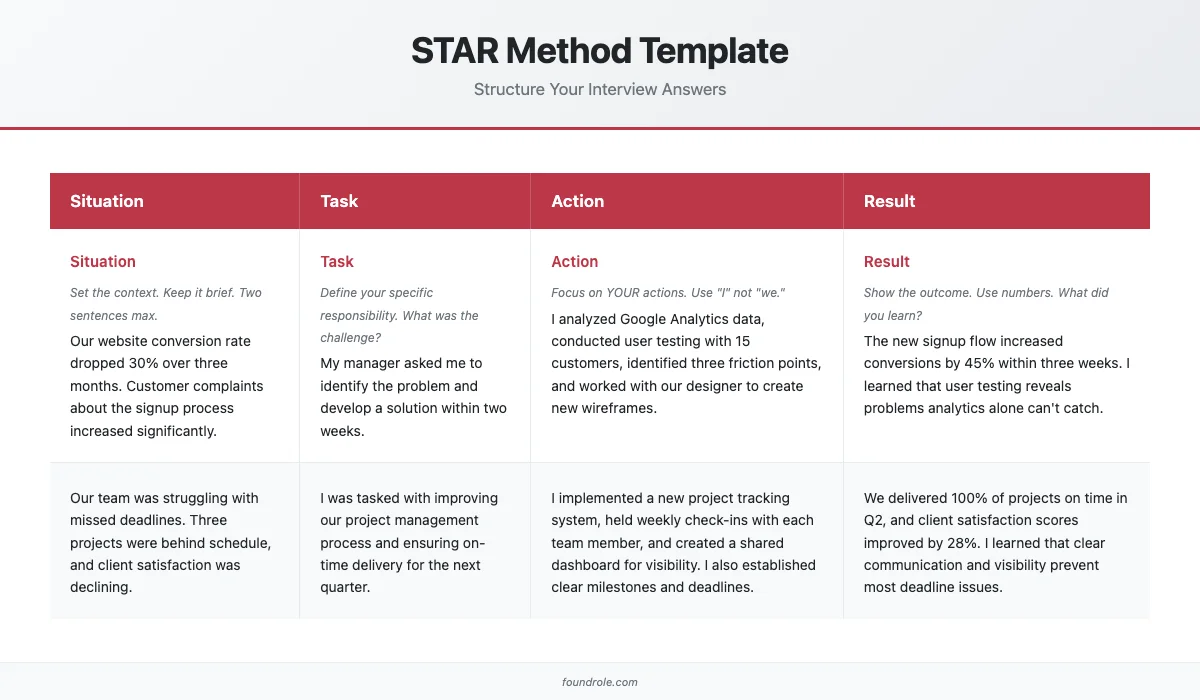
Example: Don't just say "I'm good at problem-solving." Structure it with STAR: "Situation: Our website conversion rate dropped 30% over three months. Task: My manager asked me to identify the problem and develop a solution within two weeks. Action: I analyzed Google Analytics data, conducted user testing with 15 customers, identified three friction points, and worked with our designer to create new wireframes. Result: The new signup flow increased conversions by 45% within three weeks, and I learned that user testing reveals problems analytics alone can't catch."
Understanding STAR
Situation sets the context. Keep it brief. Two sentences max.
Task defines your specific responsibility. What was the challenge?
Action is where you shine. Focus on YOUR actions, not the team's. Use "I" not "we."
The result shows the outcome. Use numbers whenever possible. What did you learn?
Common Interview Questions
Prepare 5-7 STAR stories that you can adapt to different questions:
"Tell me about yourself." Structure it as a career narrative: where you started, key growth moments, and why you're here now. Keep it under two minutes.
"Why do you want to work here?" Reference specific things you learned from your research: their recent product launch, their approach to remote work, their growth trajectory. Connect it to your career goals.
"Describe a challenge you overcame." Use a STAR story that shows problem-solving and resilience. Pick a real challenge, not a humble-brag.
"Tell me about a time you failed." Be honest. Pick a real failure where you learned something valuable. Spend most time on what you learned.
Behavioral questions follow patterns: leadership, teamwork, and conflict resolution. Prepare one STAR story for each category.
Checklist:
- 5-7 STAR stories written
- Each story has Situation, Task, Action, and Result
- Stories cover: leadership, teamwork, problem-solving, failure, achievement
- Practiced out loud (not memorized word-for-word)
- Numbers/outcomes included in Results
Don't worry if you don't have impressive results to share—especially if you're entry-level. Focus on what you learned, even from small projects. "I organized a campus event that 200 students attended" is a valid result. The key is showing your thought process and growth.
Step 3: Align Your Personal Brand Across All Touchpoints
Action: Update your LinkedIn profile, review your resume, and check your portfolio or GitHub. Ensure they all tell the same story. Do this before the interview.
Why: Interviewers check your LinkedIn, review your resume, look at your portfolio, and sometimes Google you. Inconsistencies raise red flags. If your resume says you "led a team of five," your LinkedIn should reflect that, and you should have a STAR story ready about that leadership experience.
Example: Make sure job titles match across your resume and LinkedIn. If you have an employment gap, frame it positively: "I took six months to care for a family member, during which I also completed an online certification in data science." This demonstrates intentional growth, not random job-hopping.
Resume-LinkedIn-Interview Alignment
Your resume, LinkedIn profile, and interview answers should tell the same story. Look for gaps or discrepancies. If you left a job after six months, be ready to explain why without badmouthing your former employer.
Update your LinkedIn before the interview. Recruiters routinely check LinkedIn during or right after interviews. Make sure your profile is current, your headline is clear, and your experience matches your resume.
For technical roles, ensure your portfolio or GitHub aligns with your interview narrative. If you claim expertise in React, your GitHub should show React projects.
Authenticity Balance
Here's a counterintuitive truth: perfectly polished answers can hurt you. In 2026, many companies use AI tools to analyze interview responses for authenticity. Overly rehearsed answers trigger red flags.
Practice your STAR stories enough to know the key points, but don't memorize them word-for-word. Natural speech includes pauses and slight tangents. Pausing to think before answering shows thoughtfulness, not unpreparedness.
It's okay to say "I don't know" or "I haven't encountered that situation, but here's how I'd approach it." Admitting knowledge gaps with a plan shows self-awareness.
Checklist:
- Resume and LinkedIn match (job titles, dates, descriptions)
- Portfolio/GitHub aligns with interview narrative
- Employment gaps explained positively
- Recent projects/certifications added
- Headline is clear and current
This might feel like you're being fake or inauthentic. But alignment isn't about changing who you are. It's about presenting your authentic self consistently across all touchpoints. You're not creating a false persona—you're ensuring your best self shows up everywhere.
Step 4: Test Your Technical Setup for Video Interviews
Action: Set up your camera, lighting, audio, and internet connection. Do a 30-minute practice session with a friend 24 hours before your interview. Test again 30 minutes before.
Why: According to Gartner's research, 86% of organizations conducted virtual interviews, and 61% of recruiters plan to continue using them. Video has become the norm for first-round interviews. Technical problems during these interviews cost you opportunities. Most candidates skip this step, making proper setup a simple differentiator.
Example: Test everything beforehand—don't wait until the interview to discover your microphone doesn't work. Record yourself speaking and listen back. Check your internet speed (you need at least 3-5 Mbps upload and download). Position your camera at eye level—looking down makes you appear disengaged.
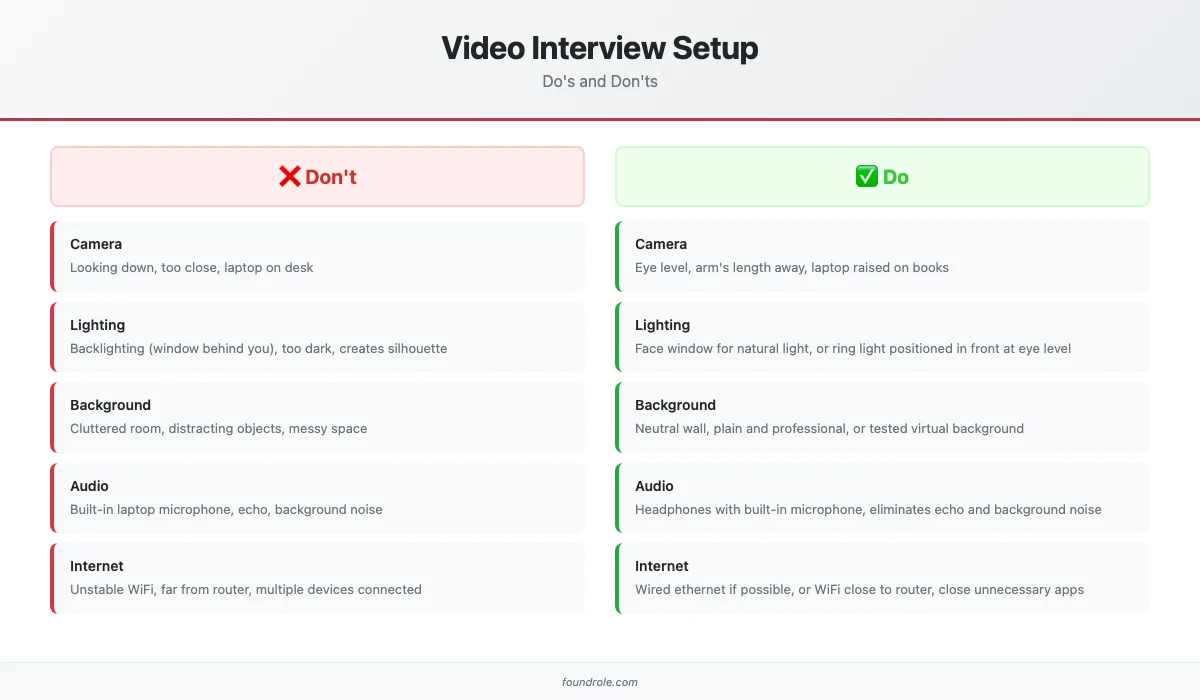
Professional Setup
Camera placement: Position at eye level, about an arm's length away. If you're using a laptop, put it on a stack of books to raise it.
Lighting: Face a window for natural light, or use a ring light positioned in front of you at eye level. Avoid backlighting (light source behind you), which turns you into a silhouette.
Background: Choose neutral and professional. A plain wall works fine. If your space is messy, use a virtual background, but test it first.
Audio: Use headphones with a built-in microphone. This eliminates echo and background noise. Test your audio by recording yourself and listening back.
Internet: Use wired Ethernet if possible. It's more stable than WiFi. If you must use WiFi, sit close to your router and close unnecessary applications. Run a speed test before your interview.
Testing Checklist
24 hours before:
- Camera positioned at eye level
- Lighting tested (natural or ring light)
- Background checked (neutral, professional)
- Audio tested (headphones with mic)
- Internet speed tested (3-5 Mbps minimum)
- Platform downloaded and tested (Zoom, Teams, Google Meet)
- Practice session with a friend completed
30 minutes before:
- Final technical test (camera, audio, internet)
- Unnecessary applications closed
- Phone silenced
- Water nearby
- Interviewer's phone number ready (backup plan)
You might think your setup is fine, but technology fails at the worst times. A 30-minute test session with a friend reveals problems you wouldn't notice alone. Is your camera angle flattering? Is your audio clear? Are there distracting background noises? Better to find out 24 hours before than during the interview.
Have backup plans ready: the interviewer's phone number and an alternative device. If your internet connection drops, call immediately to explain and reschedule if needed.
Step 5: Practice Body Language and Communication
Action: Practice looking at your camera (not your screen) while speaking. Record yourself answering one STAR story. Watch it back and note your posture, gestures, and facial expressions.
Why: What you say matters, but how you say it matters just as much. Body language, tone, and pacing all communicate confidence and engagement—or nervousness and disinterest. In video interviews, these signals are amplified. Eye contact, posture, and gestures can make or break your first impression.
Example: Looking at the interviewer's face on your screen makes it appear like you're looking down at them. Practice looking at the camera lens while speaking instead. It feels unnatural at first, but it makes a huge difference. Sit up straight, frame yourself so your head and upper chest are visible, and use hand gestures naturally within the frame.
Video Body Language
Eye contact: Look at your camera, not your screen. Practice looking at the camera lens while speaking.
Posture: Sit up straight with your shoulders back. Frame yourself so your head and upper chest are visible—not too close, not too far.
Gestures: Use hand gestures naturally, but keep them within frame. Gestures emphasize points and show enthusiasm.
Facial expressions: Smile when appropriate. Nod to show you're listening. Raise your eyebrows slightly when interested. These micro-expressions signal engagement.
Active Listening
Pause before answering questions. A two-second pause shows you're thinking, not reciting rehearsed answers. It also prevents you from interrupting if the interviewer is still speaking (video lag makes this common).
Ask clarifying questions when needed. "Just to make sure I understand, you're asking about [restate question]?" This demonstrates engagement and ensures you're answering the right question.
Mirror the interviewer's energy and pace. If they're formal and measured, match that tone. If they're casual and fast-paced, you can be more relaxed.
Checklist:
- Practiced looking at the camera (not screen)
- Posture checked (straight, shoulders back)
- Gestures practiced (natural, within frame)
- Facial expressions aware (smile, nod, engagement)
- Pausing before answers is practiced
- Clarifying questions prepared
Being yourself is the goal, but video interviews require different skills than in-person. Looking at the camera feels unnatural because you want to look at the person's face. But to them, it looks like you're looking down. Practice makes this feel natural.
For more on what to avoid, see our interview mistakes to avoid guide.
Step 6: Prepare Your Follow-up Strategy
Action: Draft your thank-you email template now, before the interview. Personalize it after the interview with specific conversation topics. Send it within 24 hours.
Why: The interview doesn't end when you hang up. Your follow-up strategy can be the difference between an offer and silence. Most candidates skip thank-you emails entirely, making this a simple way to stand out in a market where recruiter ghosting has become increasingly common, with 61% of candidates ghosted after interviews according to The 2025 Ghosting Index.
Example: Avoid generic "Thank you for your time" messages. Reference specific topics: "I enjoyed our conversation about your team's approach to agile development, especially the two-week sprint cycle." This proves you were paying attention and makes your email memorable.
The 24-Hour Rule
Send your thank-you email within 24 hours. Sooner is better—it shows enthusiasm and keeps you fresh in their mind.
Personalize based on your conversation. Reference specific topics you discussed.
Keep it brief. Three to four paragraphs max.
Email Template
Standard thank-you:
Subject: Thank you - [Your Name] - [Position Title] Interview
Hi [Interviewer Name],
Thank you for taking the time to speak with me today about the [Position Title] role. I enjoyed learning about [specific topic discussed] and how your team approaches [specific challenge or project].
Our conversation reinforced my interest in this opportunity. My experience with [relevant skill/experience] aligns well with your need for [specific requirement they mentioned].
Please let me know if you need any additional information from me. I look forward to hearing about next steps.
Best regards, [Your Name]
Multi-Touchpoint Strategy
Connect with your interviewer on LinkedIn a day or two after your thank-you email. Include a brief note: "Thanks again for the great conversation about [topic]. Looking forward to staying connected."
If you come across relevant news or articles, share them. This keeps you top-of-mind without being pushy.
Checklist:
- Thank-you email template drafted
- Interviewer's email address saved
- LinkedIn connection request prepared
- Timeline expectations noted (when to follow up)
Worried about seeming pushy? A thoughtful LinkedIn connection with a brief note is professional networking, not pushy. Most candidates don't do this, making it another differentiator. Just don't send multiple messages—one thank-you email and one LinkedIn connection is enough.
Sign up for FoundRole and click "Get alerts" to receive notifications about new job openings that match your search criteria.
Self-Assessment: Are You Interview-Ready?
Before your interview, evaluate your readiness using this scorecard. Rate each area from 1-10, then add your scores for your overall readiness.
Company Research Depth — Your score: ___/10 Have you completed the 7-point framework? Can you speak knowledgeably about their culture, recent news, competitors, and products?
Answer Preparation (STAR Method) — Your score: ___/10 Have you prepared 5-7 STAR stories covering different competencies? Can you adapt them to various questions?
Technical Setup Tested — Your score: ___/10 Have you tested your camera, lighting, audio, and internet connection? Did you do a practice run with a friend?
Personal Brand Alignment — Your score: ___/10 Are your resume, LinkedIn, and portfolio consistent? Have you updated all profiles recently?
Body Language Practice — Your score: ___/10 Have you practiced looking at the camera? Are you aware of your facial expressions and gestures?
Follow-up Plan Ready — Your score: ___/10 Do you have thank-you email templates ready? Do you know the interviewer's email and LinkedIn?
Overall Readiness Score — Total: ___/60
Interpretation:
- 45-60: You're well-prepared. Review your lowest-scoring areas for final polish.
- 30-44: You need more preparation. Focus on your lowest-scoring areas first.
- Below 30: Prioritize the most critical areas: company research, STAR stories, and technical setup.
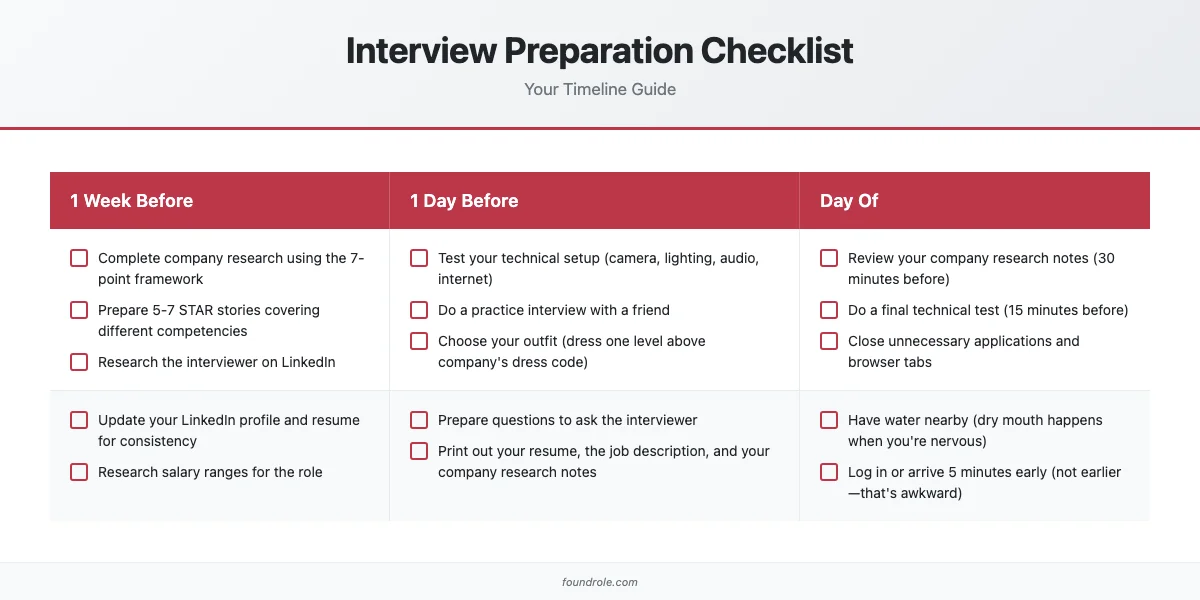
Timeline
1 week before:
- Complete company research using the 7-point framework
- Prepare 5-7 STAR stories covering different competencies
- Research the interviewer on LinkedIn
- Update your LinkedIn profile and resume for consistency
- Research salary ranges for the role
1 day before:
- Test your technical setup (camera, lighting, audio, internet)
- Do a practice interview with a friend
- Choose your outfit (dress one level above the company's dress code)
- Prepare questions to ask the interviewer
- Print out your resume, the job description, and your company research notes
Day of:
- Review your company research notes (30 minutes before)
- Do a final technical test (15 minutes before)
- Close unnecessary applications and browser tabs
- Have water nearby (dry mouth happens when you're nervous)
- Log in or arrive 5 minutes early (not earlier—that's awkward)
Note for global candidates: Interview expectations vary by culture. In some European markets, formality is more valued. In Asian markets, showing respect for hierarchy matters more. In US markets, authenticity and results are prioritized. Adapt your approach based on the company's location and culture.
Create a free FoundRole account to track your interview prep, save job applications, and get personalized interview tips based on your target roles and experience level.
Conclusion
Interview preparation isn't about memorizing perfect answers or projecting a fake persona. It's about systematically preparing across every touchpoint so you can show up as your best, most authentic self.
Systematic preparation beats generic advice. According to Indeed's 2024 Workforce Insights Report, while 69% of job seekers are optimistic about their search, only 35% systematically update their materials. Deep preparation puts you in the minority of truly competitive candidates.
Consistency across touchpoints matters. Your resume, LinkedIn, portfolio, and interview narrative must tell the same story. Interviewers check multiple sources, and inconsistencies raise red flags.
Follow-up is a differentiator. Most candidates skip the thank-you email, making this a simple way to stand out.
You now have a complete interview preparation system: a 7-point company research framework, STAR method templates, a technical setup checklist, body language strategies, follow-up email templates, and a readiness scorecard. This systematic approach is what separates top candidates who treat their job search like a professional marketing campaign from those who wing it.
Ready to put this preparation framework into action? Browse jobs on FoundRole, find roles that match your skills, sign up, and click "Get alerts" to receive notifications about new openings..