AI in Job Search: Why Your Resume Gets Filtered Out (And What to Do Next)
Sending out dozens of applications with zero responses? The hidden blocker often isn't your qualifications - it's the screening layer before a human ever sees your resume. About 97.8% of Fortune 500 companies use an applicant tracking system (ATS), which filters and ranks candidates at the top of the funnel before recruiters review applications.
SHRM research shows 24% of U.S. organizations use AI or automation for HR tasks, including recruiting, and that number is growing. That's why you can be qualified on paper and still get stuck in the automated first round.
Think of modern job applications like airport security. Your resume is your ticket, but ATS is the checkpoint you must pass before you reach the gate (a human recruiter). If you don't know what triggers the alarm, you keep getting stopped - without ever knowing why.
In this guide, we'll break down how AI screening works, what these systems look for, and how to adapt your job search so you reach real recruiters - not just inbox auto-replies.
How AI is Used in Hiring
AI now plays a central role in how organizations find and evaluate talent. Jobscan's 2025 ATS Usage Report found that 97.8% of Fortune 500 companies have a detectable ATS for resume screening - making ATS virtually unavoidable at large employers.
ATS systems: the first gatekeeper. When you apply, an ATS receives your resume first. It parses the document, converts it into a structured profile, and scores your qualifications against the job description. Only candidates meeting certain thresholds reach human recruiters - often within seconds.
AI screening and candidate matching. Beyond basic parsing, many recruiting tools use algorithms to evaluate candidate fit. Some models compare your profile against patterns from successful hires, then surface recruiters a ranked shortlist instead of a raw inbox of applications.
Chatbot recruiters for initial screening. AI chatbots handle scheduling, answer questions, and sometimes run preliminary screening via text. For job seekers, this can mean faster responses - but it also means your early interactions may be evaluated algorithmically before a human ever reviews your profile.
Ready to optimize for AI screening? Pick one role on FoundRole, then tailor your resume to that job description before you apply.
AI Resume Screening: How It Works
How ATS systems parse your resume. When an ATS receives your resume, it extracts structured information by looking for standard sections like "Experience", "Education", and "Skills". It pulls dates, company names, job titles, and credentials, then maps them into database fields. If your formatting is complex or your section titles are unusual, parsing can fail - and when parsing fails, that information becomes invisible to recruiters. In ATS screening, format matters as much as content.
What gets filtered out (and why). ATS tools typically filter based on keyword match and requirement thresholds. For example, if a job description says "Python programming" and your resume says "Python scripting", some systems may not treat those as equivalent. AIQ Labs notes that many applications never reach recruiters due to automated filtering and parsing issues. Beyond keywords, missing requirements like years of experience, education level, or certifications can push your application below the threshold recruiters review.
Common formatting mistakes to avoid. Tables and text boxes often don't translate cleanly into plain text. Headers and footers may be ignored, which means critical information placed there can disappear. Highly designed layouts (graphics, multi-column formats, unusual spacing) can break parsing. The safest setup: simple formatting, standard fonts, clear section headings, and left-aligned text. File format matters too; most modern ATS can handle .docx and PDF, but always follow the job posting's instructions.
| Criteria | ATS Screening | Human Screening |
|---|---|---|
| Speed | Seconds | Days to weeks |
| Focus | Keywords, format, requirements checklist | Experience, fit, potential, communication style |
| What Matters Most | Exact keyword matches, standard structure, parseable format | Relevant achievements, clear communication, cultural alignment |
| Biggest Mistakes | Creative formatting, missing keywords, non-standard headings | Generic content, lack of specifics, poor storytelling |
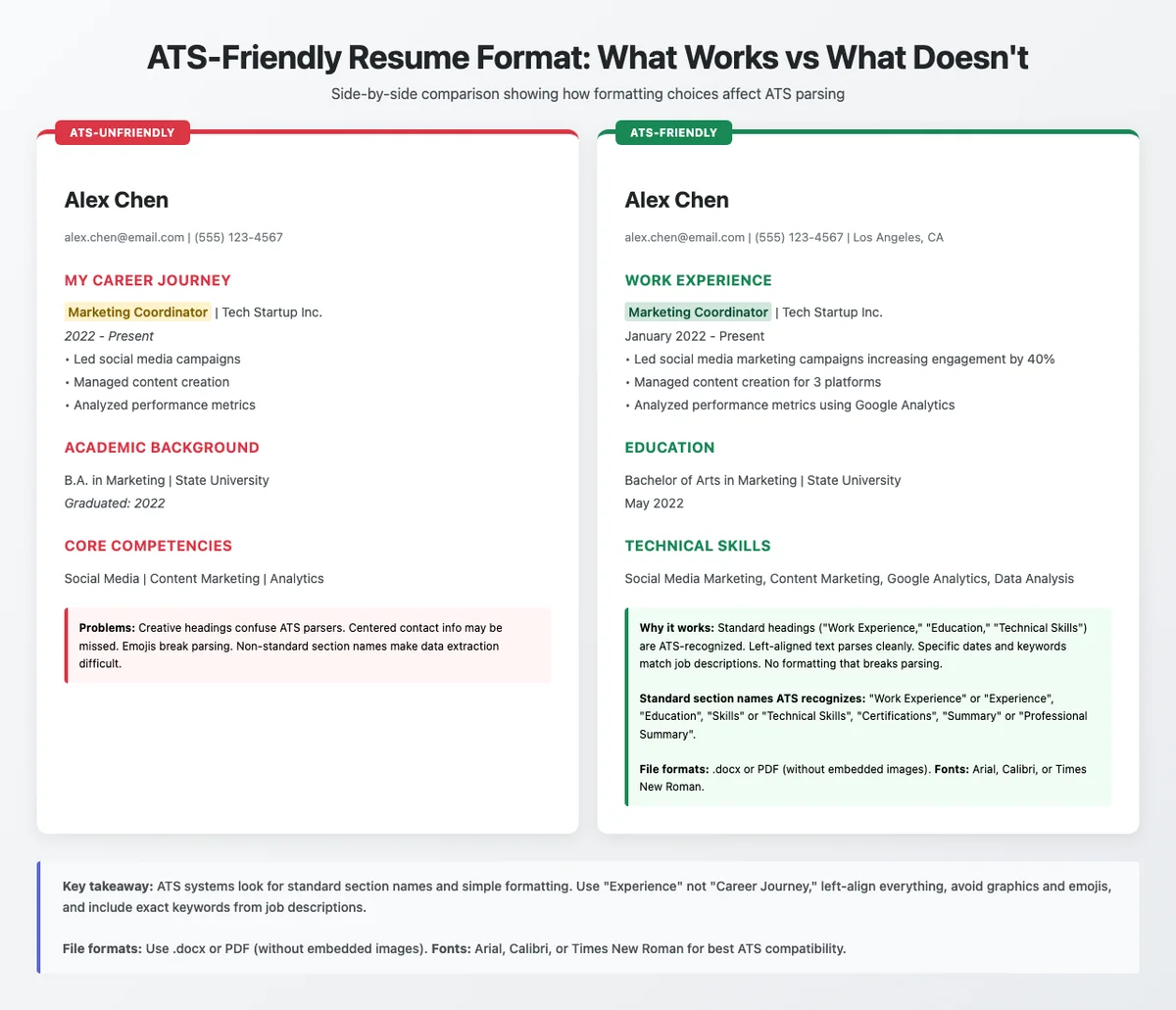
The difference between ATS and human screening becomes clear when you see how formatting choices affect parsing. Here's a side-by-side comparison of what works and what doesn't:
 Want a deeper walkthrough? See our Resume with No Experience.
Action step: Pick one job on FoundRole, then run a quick ATS check: headings, keywords, and formatting. Fix the gaps before you apply.
AI-Powered Interview Tools
Recent survey data shows that about 24% of companies already use AI to run the entire interview process (including asking questions and analyzing candidates' responses, often via video interviews), with that share projected to reach 29% by 2025, primarily among larger organizations.
Video interview analysis (what it may evaluate). Some AI-enabled interview platforms analyze signals like speaking pace, clarity, word choice, and how consistently your answers follow the prompt. Some tools also claim to assess nonverbal cues (like eye contact and facial expressions), especially in recorded video interviews.
How to prepare (what you can control). Treat video interviews like a high-signal format: set up good lighting, use a stable camera angle, and speak clearly at a moderate pace. Look at the camera when making key points (it reads as confidence), and structure every answer so it's easy to follow - especially for multi-part questions. Use specific examples over vague claims. And don't over-script: practice your structure, but keep your delivery natural.
How to Optimize Your Job Search for AI
Follow these four steps to get past ATS systems and reach human recruiters:
1. Use standard section headings. Replace creative headings with ATS-recognized standards. Most systems look for names like "Experience", "Education", and "Skills". Headings like "Career Journey" can confuse parsing and make key information harder to extract.
Examples: "Career Journey" → "Experience" | "Academic Background" → "Education" | "Core Competencies" → "Skills"
2. Match keywords from the job description. Take one job description and highlight 5-7 key skills or requirements. Are those exact phrases in your resume? Many systems rank candidates partly by keyword match. If the posting says "project management" and your resume only says "project coordination", some tools may not treat them as equivalent.
Example: Job says "Experience with Salesforce CRM"
❌ Your resume: "CRM platform experience"
✅ Your resume: "Salesforce CRM: managed client notes, pipeline updates, and reporting"
3. Avoid formatting that breaks ATS parsing. Tables and text boxes often don't convert cleanly into plain text. Headers and footers can be ignored. The safest approach is simple: standard fonts (Arial, Calibri, Times New Roman), left-aligned text, and clear section headings.
4. Test before you apply. Copy your resume and paste it into Notepad. Does it still read clearly? If it becomes confusing in plain text, that's a sign the ATS may struggle to parse it too.
The doubt: "This feels robotic and removes my personality". That's normal. Here's the reframe: personality wins in interviews. Getting past ATS is about clarity and matching language - so a human actually gets the chance to meet you.
Future of AI in Hiring
AI in recruiting will keep evolving. We'll see more automation in the unglamorous parts of hiring - scheduling, screening questions, candidate matching, and follow-ups. Some tools will get better at pattern recognition (what resumes and answers tend to correlate with successful hires), but that doesn't mean they're perfect - or fair.
Bias concerns (and why they matter). AI bias in hiring has become a significant concern. Pew Research data shows 53% of Americans oppose using AI for hiring decisions, and 71% believe it will worsen fairness. In response, some jurisdictions are beginning to require audits of AI hiring tools and more transparency around automated decisions.
What to expect as a job seeker. AI tools will become more common across hiring stages, which makes "AI-ready" applications a baseline skill. But human judgment still matters: AI may handle early filtering, while hiring managers evaluate context, communication, and team fit in later rounds. The goal isn't to outsmart the system - it's to understand how it's used so you can reach real decision-makers.
Start Your Job Search Today
If you're applying without adapting for ATS, you're guessing. A few small changes can be the difference between silence and a callback - because your resume has to be readable to the system before it's readable to a recruiter.
Getting past ATS isn't about gaming the system. It's about clarity and alignment. You're not changing what you offer; you're translating it into a format the ATS can parse, and the recruiter can quickly understand.
Here's your simple loop for the next 7 days:
-
Pick one job description you actually want
-
Highlight 5–7 key requirements/keywords in the posting
-
Update your resume (headings, keywords, and order of bullets) to match what matters most
-
Run a quick ATS test: paste your resume into Notepad and check that it still reads cleanly
-
Submit the application
-
Repeat with the next role (small edits, not a full rewrite)
This is how you stop sending "blind" applications - and start reaching real recruiters.